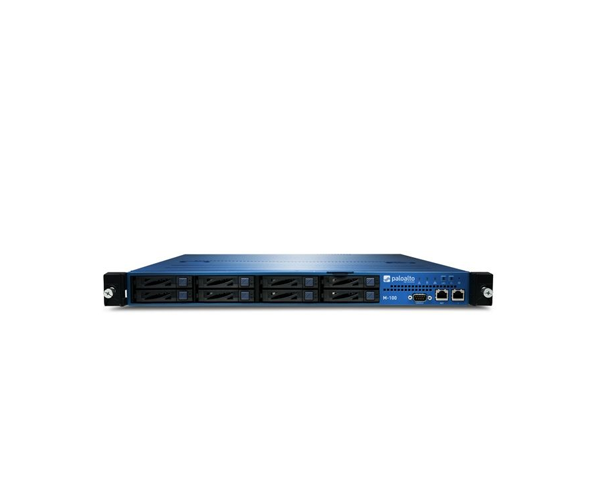
Specification
| Specification |
Details |
| Part Number |
PAN-M-100 |
| Description |
Palo Alto Networks PA-M-100, Network management device, GigE, 1U, rack-mountable |
| I/O |
(1) 10/100/1000, (3) 10/100/1000 (for future use), (1) DB9 Console serial port |
| Storage |
1TB RAID: 2 x 1TB RAID Certified HDD for 1TB of RAID Storage |
|
4TB RAID: 8 x 1TB RAID Certified HDD for 4TB of RAID Storage |
| Power Supply/Max Power Consumption |
500W/500W |
| Max BTU/hr |
1,705 BTU/hr |
M-100 Overview
Panorama provides centralized management and visibility of Palo Alto Networks next-generation firewalls. From a central location, administrators can gain insight into applications, users, and content traversing the firewalls. The knowledge of what is on the network, in conjunction with safe application enablement policies, maximizes protection and control while minimizing administrative effort. Administrators can centrally perform analysis, reporting, and forensics with the aggregated data over time or on data stored on the local firewall.
Both Panorama and the individual devices share the same web-based look and feel, minimizing any learning curve or delay in executing tasks. Palo Alto Networks adheres to a management philosophy that emphasizes consistency, providing a significant advantage over competitive offerings.
Key Features:
- Application Command Center (ACC): Provides a visual summary of application, web, threat, and data transfer activity displayed in a straightforward, easy-to-understand manner. Administrators can quickly learn more about the network activity by adding and removing filters in ACC with a click of the mouse.
- App-Scope: Provides a comparative view of application activity (present vs. a past timeframe) across either multiple devices or a single device to help administrators pinpoint problematic network behavior.
- Policy-Based Application Usage Control: Using a policy editor with a familiar look and feel, administrators can develop, deploy, and manage application usage control policies using a wide range of criteria such as user and group, application, application category, application behavior, or underlying technology.
- Shared Policies: Deploy a set of global policies across a set of distributed firewalls. Local device administrators will be able to see these rules, but only a Panorama administrator can modify or remove them.
- Centralized Update Management: Customers can use Panorama to manage licenses and perform device or content updates (virus patterns, threat signatures, App-ID).
- Application Browser: Allows administrators to quickly research an application, its behavioral characteristics, and underlying technology and then immediately translate the results into a security policy.
- Logging: Detailed logs are collected locally, leveraging device storage and eliminating the requirement for centralized logging. Logs can be dynamically filtered on individual fields as well as through regular expressions.
- Reporting: More than 30 predefined reports can be used as-is or modified and saved for future use. Reports can be exported to PDF and scheduled for email delivery.
Comparison to Similar Items
| Model |
Description |
I/O |
Storage |
Power Supply/Max Power Consumption |
Max BTU/hr |
| PAN-M-500 |
Palo Alto Networks PA-M-500, Network management device, 10 GigE, 2U, rack-mountable |
(4) 10/100/1000, (1) DB9 console serial port, (1) USB port, (2) 10 GigE ports |
Maximum configuration: RAID: 24 x 2 TB RAID Certified HDD for 24 TB of RAID storage |
Dual power supplies, hot swap redundant configuration, 1200W/493W (total system) |
1,681 BTU/hr |
| PAN-M-100 |
Palo Alto Networks PA-M-100, Network management device, GigE, 1U, rack-mountable |
(1) 10/100/1000, (3) 10/100/1000 (for future use), (1) DB9 Console serial port |
1TB RAID: 2 x 1TB RAID Certified HDD for 1TB of RAID Storage
4TB RAID: 8 x 1TB RAID Certified HDD for 4TB of RAID Storage |
500W/500W |
1,705 BTU/hr |